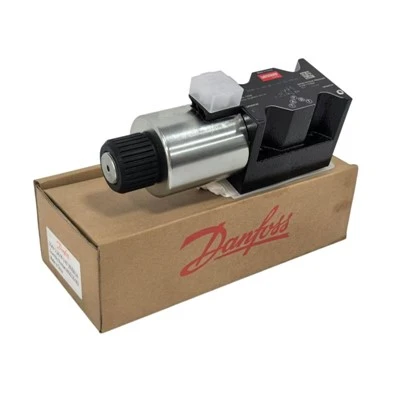
Danfoss DG4V-5-2ALJ-M-U-H7-29 Solenoid Valve For Hydraulic Power Units, Press Machines, Machine Tools And Automation Systems

Danfoss DG4V-5-2ALJ-M-U-H7-29 Solenoid Valve For Hydraulic Power Units, Press Machines, Machine Tools And Automation Systems

The Danfoss DG4V-5 directional control valve is designed for hydraulic flow switching and actuator control.
It is widely applied to hydraulic presses, CNC machine tools, injection molding machines, lifting equipment and material handling systems.
The valve supports hydraulic applications across metalworking, manufacturing, automation and industrial equipment.
Send Inquiry
Description
Technical Parameters
Directional control · size 05 · 315 bar

DG4V-5, chosen for what it does not do

It does not need a new manifold, it does not care whether your supply is AC or DC, and it does not need a duty-cycle calculation before the coil can stay energised all shift. Everything below is what a specifier actually has to decide.

315 bar
ports P, A and B
210 bar
tank port on DC builds
ED 100%
continuous, no derating
150 yr
MTTFd to ISO 13849

Three builds, one valve body

The choice nearly always comes down to these three. The hydraulics barely change; what changes is the fail position, the return-line ceiling and how much current the coil draws.

BUILD ONE
AC, single solenoid
Spring offset or spring centred. The usual answer where the machine is already wired for AC and the return line is lightly loaded.
Working ports - 315 bar
Tank port - 120 bar
Ambient ceiling - 50 °C at 50 Hz, 40 °C at 60 Hz
Overall length - 182 mm
Mass - 4.0 kg
BUILD TWO · MOST SPECIFIED
DC, single solenoid
The easier specification in almost every respect: 90 bar more on the return line, 30 °C more ambient headroom, and a shift you can slow down with an orifice plug.
Working ports - 315 bar
Tank port - 210 bar
Ambient ceiling - 70 °C
Overall length - 215 mm
Mass - 4.8 kg
BUILD THREE
DC, double solenoid
Spring centred C or detented N. Take N when the spool has to stay exactly where it was put, including through a power loss.
Working ports - 315 bar
Tank port - 210 bar
Ambient ceiling - 70 °C
Overall length - 312 mm
Mass - 6.3 kg

Three model codes, read out loud

Cross-referencing an old valve is the most common reason people land on this page. Here is what the blocks mean on three codes that come up again and again.

DG4V-5-2CJ-M-U-H7-29
Spool 2 with spring centred arrangement C, double solenoid. The J is the spool design that goes with this spool on a DC valve. M fixes the solenoid layout, U means the coil comes without a plug, H is the 24 V DC coil, 7 sets the tank rating at 210 bar, and 29 is the design number.
DG4V-5-2AJ-M-U-H7-29
Same 24 V DC electrics and the same 210 bar tank rating, but spool 2 with spring offset arrangement A on a single solenoid. On a power loss the spool drives to one fixed end, which is what you want when the actuator has a safe resting position.
DG4V-5-2C-M-U-C6-29
An AC build: no J block, because that spool design applies to DC valves and to the 8B and 8C spool arrangements only. C is the 220 V 50 Hz coil rating and the 6 digit sets the tank rating at 160 bar, which is the AC-only ceiling.

Always work from the nameplate on the valve you are replacing. Send it to us and we will verify each block before quoting.

Specification, unabridged

Interface ISO 4401 Size 05 - also ANSI/B93.7M-D05, CETOP 5, NG10, NFPA D05
Construction Four-port, four-land spool, gasket mounted
Pressure, ports P / A / B 315 bar (4,500 psi)
Pressure, port T 210 bar DC (3,000 psi) · 120 bar AC (1,750 psi)
Flow rating Per spool performance curve, plotted to 120 L/min (30 US gpm)
Relative duty factor Continuous, ED = 100%
Solenoid Wet armature, AC and DC options
Electrical connection ISO 4400 (DIN 43650), indexable at 90 degree intervals
Coil ratings 12, 24, 48 and 110 V DC · 110, 220 and 240 V AC at 50 Hz · 115 and 230 V AC at 60 Hz · 24 V AC at 50 Hz
Power consumption, DC 38 W on full power coils, 32 W on the HL coil
Response, 2C spool AC 30 ms in and 40 ms out · DC 120 ms in and 45 ms out
Insulation and protection Class H winding, Class F encapsulation, IEC 144 class IP65 with the plug fitted
Voltage tolerance Holds in down to 90% of rated
Ambient temperature −20 °C to 70 °C DC, 50 °C AC 50 Hz, 40 °C AC 60 Hz
Manual override Plain standard · H water-resistant · W twist and lock · Z none
Spool position monitoring Option 57 switch on single solenoid valves · S9 monitoring function
Spools and springs 17 spool functions in spring offset, spring centred and detent arrangements, all with left-hand builds
Dimensions and mass 182 / 246 mm and 4.0 / 4.5 kg on AC · 215 / 312 mm and 4.8 / 6.3 kg on DC, single and double
Reliability MTTFd 150 years to ISO 13849
Service parts Seal kit 459057 AC, 459058 DC · orifice plug kit 459065 · port orifice kit 02-350116

Five reasons it keeps getting specified

01
The manifold you already have
Size 05 is the pattern the industry settled on, so no redrilling, no adapter plate, no revised drawing. If the old valve came off a CETOP 5 or NG10 panel, this one goes back on.
02
AC or DC without redesigning anything
Both solenoid families mount on the same body. Changing a machine's supply voltage for a new market is a coil ordering decision, not an engineering project.
03
A shift you can make quieter
All DC models take a variable changeover speed. Four orifice plug sizes let you stretch the stroke until the pressure spike stops rattling the pipework.
04
Long holds, no arithmetic
ED = 100% means the coil can stay energised as long as the machine needs. Class H winding and a 90 per cent voltage floor keep it holding where the supply is soft.
05
Parts that can be bought, not just a valve that can be replaced
Seal kits split by AC and DC build, orifice plug kits and individual coils are all separate orderable items. A repairable valve spends more of its life on the machine, and less in a box on a shelf.

Where it ends up on the line

Three cell types account for most of the valves that leave our shelves. The duty in each one is unglamorous and constant, which is exactly what an on-off directional valve is for.

Moulding cell
On an injection moulding machine the clamp opens, closes, and then sits there holding tonnage for as long as the cycle takes. The ejector strokes, the cores pull, and on a die-caster the shot fires. Every one of those is a switched flow, and the long clamp hold is why the continuous duty rating matters more than any peak figure.
Machining cell
A vice or a chuck clamps the part, an index table rotates it, a tailstock comes up behind it, a tool changer swings in. Nothing travels far, but the sequence repeats all day and a missed confirmation stops the spindle. This is where the spool position switch option earns its place.
Power unit and test stand
One pump, several branches, and a valve deciding which branch is live while the rest goes back to tank. On a test bench the same valve steps a sequence through its stages. The return line here is the thing that decides whether you can stay on AC.
Beyond the shop floor: the same size 05 body sequences the boom and outriggers on a concrete pump truck, picks between implements on an excavator, positions roll balance cylinders in a steel mill, releases brakes and drives slewing gear on mining plant, and works deck winches and hatch covers on marine and offshore installations.

Before you order

What are the hard limits I must not exceed?
Working ports 315 bar. Tank port 210 bar on DC and 120 bar on AC. Ambient from −20 °C up to 70 °C on DC, 50 °C on 50 Hz AC and 40 °C on 60 Hz AC. The valve must hold at no less than 90 per cent of rated voltage. Everything else you can work with; those five are the ones that void the rating.
Is 315 bar the same as the 350 bar figure quoted elsewhere?
No, and it matters. For this valve the working ports are rated 315 bar (4,500 psi), which is what the V in the model code sets. The 350 bar figure that circulates online for DG4V valves belongs to the smaller size 03 body and has been copied across to this size by mistake. Size to 315 bar, and check the nameplate before you commission.
What should I check before ordering a replacement?
Five things. The full model code including the design number. Whether the build is AC or DC and at which voltage. The spool function and spring arrangement, because that sets the fail position. The actual back-pressure on the return line, since that decides whether AC at 120 bar is enough. And the ambient temperature at the valve position, which decides whether you can stay on 60 Hz AC. Send those and we will confirm rather than guess.
What is the mass and overall length?
Single solenoid builds run 182 mm and 4.0 kg on AC, or 215 mm and 4.8 kg on DC. Double solenoid builds run 246 mm and 4.5 kg on AC, or 312 mm and 6.3 kg on DC. The water-resistant override option adds length, taking a double DC build to 370 mm.
Are there fluid restrictions I should know about?
The standard build covers petroleum-based hydraulic oil, water-in-oil invert emulsions and phosphate esters, whether the valve is AC or DC. Water glycol is the one that needs declaring up front: it takes the AC prefix with AC coils, or the F13 prefix with DC coils. Order the wrong prefix and the elastomers will be wrong too.
What happens if the supply drops below rated voltage?
You fall outside the specification. The published minimum is 90 per cent of rated, and at 24 V DC that means 21.6 V at the coil. Long cable runs, undersized conductors and a shared supply all eat into that margin before the valve ever sees it, so measure at the coil rather than at the cabinet terminal.
Can I order a left-hand build?
Yes. Adding L to the spool and spring arrangement gives the mirrored build, so AL and BL sit opposite their right-hand counterparts. It matters where the solenoid has to face away from the machine frame, or where the override needs to stay reachable by a maintenance hand.
What does the IP65 rating actually require of me?
It is a fitted-assembly rating, not a property of the coil on its own. IEC 144 class IP65 is achieved once an ISO 4400 coil has the correct plug fitted with its interface seal in place. Leave the plug off, or reuse a hardened seal, and the protection you were relying on is gone. The plug housing can be indexed at 90 degree intervals to keep the cable entry out of the weather.

Send the nameplate code, the quantity and the destination, and we will come back with a price and a lead time. If the valve is still being chosen, send the working pressure, the flow and what the cylinder has to do instead.

Specifications reproduce the published figures for the DG4V-5-20/22 design, ISO 4401 Size 05 solenoid operated directional valve (Danfoss literature BC442274655179en). Values are rounded and typical and do not allow for manufacturing tolerances; the nameplate on the delivered valve and the delivery documents are binding. Model codes shown are examples of the ordering structure and must be checked against the nameplate of the valve being replaced. DG4V and other marks belong to their respective owners and appear here only to identify fit and compatibility.

WeChat
13071861038
WhatsApp
+86 18593890198


Hot Tags: danfoss dg4v-5-2alj-m-u-h7-29 solenoid valve for hydraulic power units, press machines, machine tools and automation systems, China danfoss dg4v-5-2alj-m-u-h7-29 solenoid valve for hydraulic power units, press machines, machine tools and automation systems manufacturers, suppliers, factory, M 3SED6UK14 350CG24N9K4 R900052621 Solenoid Ball Valve for Rexroth, manual hydraulic valves, panel mounted valves, reliable hydraulic valves, relief valves, spool valves
Send Inquiry
Send Inquiry